

- This event has passed.
Race and Space: How Laws Create and Impact Asian Spaces
Since its origins, America has existed as a racially segregated country. For most of its history, the law has been used to create and enforce this segregation. With the Reconstruction era’s 13th, 14th, and 15th Amendments, or as historian Eric Foner calls it, the “second founding,” the U.S. abolished slavery, granted citizenship, and enshrined equality before the law, at least in principle. And yet, in fundamental ways, we still live in a racially segregated country and city. Today, many Asian New Yorkers shop, eat, worship, reside, or learn in spaces where they are surrounded by others who look like them.
This panel explores several distinct spaces where Asian New Yorkers gather and examines how laws and policies have defined, developed, policed, and shaped these Asian spaces. Featured locations include massage parlors or spas, New York City’s multiple Chinatowns, takeout restaurants, and specialized public high schools. Panelists will discuss how different areas of law such as education law, criminal law, immigration law, and zoning laws impact these places.
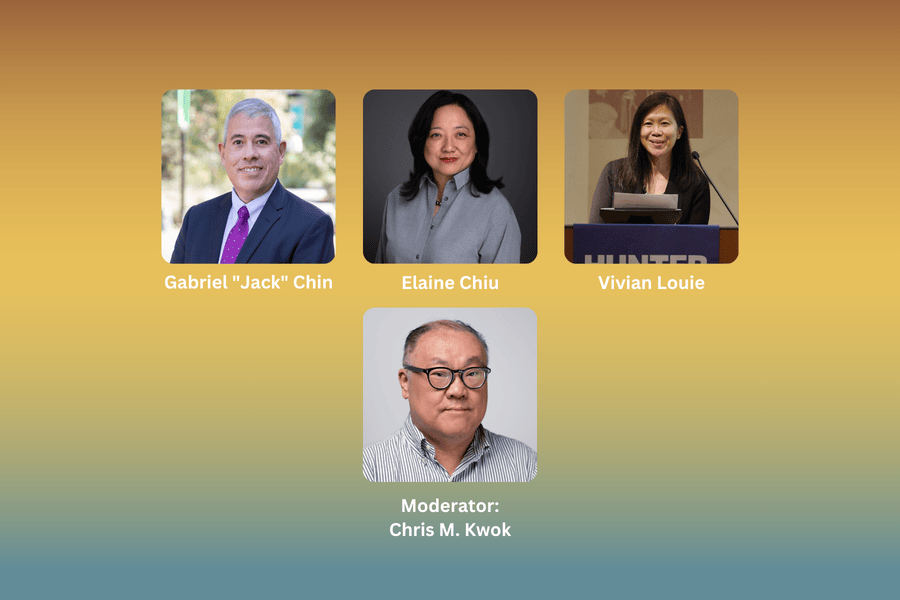
Professor Gabriel Chin, who studies historical discrimination against Asians, will start with a historical overview of anti-Asian zoning, alien land laws, land giveaways like the Homestead Act, restrictive covenants, expulsions, and segregated unions (segregating workplaces), in order to examine the role of the law in creating, protecting and harming racialized spaces. Professor Vivian Louie, an urbanist and scholar with expertise in Asian Americans and education, will explore both educational and non-educational, place-based policies that transformed New York City’s opportunity structure and created schools as “Asian,” “Black,” “Latino,” and “White” spaces. Professor Elaine Chiu, an expert in criminal law, will discuss the impact of violent attacks that occur in Asian neighborhoods and in familiar workplaces such as massage parlors, take-out restaurants, and laundromats.
Understanding the deep connection between laws and spaces in our history and in our current moment is incredibly important for tomorrow’s leaders. It reinforces a lesson that bears repeating often laws—past, present, and future—matter for people’s everyday lives, especially for the very physical spaces in which we spend those lives.
Key Takeaways
- What do today’s Asian neighborhoods mean to Asian Americans? Are they second class places that receive little support and yet bear the brunt of systemic social ills? Are they our safe spaces of cultural affirmation and identity and archives of our complicated history? What can laws do to protect and promote them?
- What is the future of Asian spaces and the law? Will there be an open return to policies that privilege White America and what will that mean for Asian Americans? Or will there be a persistent, undercurrent of anti-Asian attitudes that hinder our communities from thriving?
- Some schools and workplaces remain Asian spaces. Is this racial segregation an inevitable feature of America? What are the benefits and the costs of such segregation for Asian Americans and for others? Again, what is the role of our laws and legal systems?
CLE Information
1.5 Credits in Diversity, Inclusion and Elimination of Bias
Non-Transitional only
Speakers:
- Professor Gabriel “Jack” Chin, University of California Davis School of Law
- Professor Elaine M. Chiu, St. John’s University School of Law
- Professor Vivian Louie, Hunter College
Moderator:
- Chris M. Kwok, Adjunct Professor, CUNY Hunter College and JAMS; Co-chair, Alternative Dispute Resolution Committee